
Asbestos in Greater Manchester’s Industrial Heritage Buildings – HSG Surveys
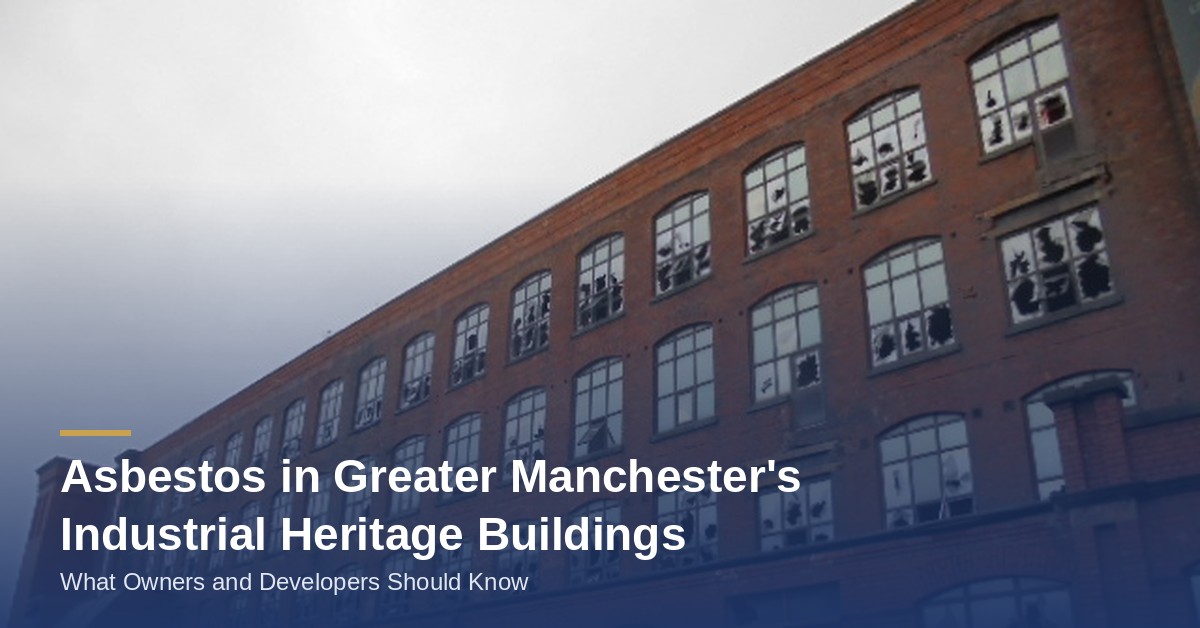
Greater Manchester’s skyline is full of converted cotton mills, canal-side warehouses, and former engineering works, many now repurposed as flats, offices, and creative spaces across Manchester, Salford, and Oldham. That industrial past comes with a practical present-day consideration: asbestos in industrial buildings across Greater Manchester is common, and anyone buying, converting, or maintaining one of these properties needs to know what to expect.
Why These Buildings Are High-Risk for ACMs
Most of Greater Manchester’s mills, warehouses, and industrial units were built or heavily modified between the late Victorian era and the 1980s, spanning exactly the period when asbestos was used extensively in construction. Common applications in this type of building include:
- Sprayed coatings on structural steelwork, used for fire protection
- Asbestos insulating board (AIB) in partition walls, ceiling tiles, and lift shafts
- Lagging on pipework and boilers, particularly in older plant rooms
- Roofing sheets and rainwater goods, especially on later 20th-century extensions
- Floor tiles and adhesives from mid-century refurbishments
Because these buildings were often extended, repaired, and repurposed multiple times over decades, the mix of materials can be more complex than in a standard domestic property, which makes a thorough survey particularly important before any conversion work begins.
What This Means for Developers and Investors
If you’re converting a former mill or industrial unit into residential or commercial space, a refurbishment survey is essential before work starts, not optional. Unlike a management survey, a refurbishment survey is more intrusive by design, since the whole point is to check behind surfaces that will be altered, opened up, or removed during the works.
Getting this right at the planning stage avoids two common and costly problems: unexpected discoveries mid-build that halt work, and contractors being exposed to materials nobody knew were there.
What This Means for Current Owners
If you already own or occupy a converted industrial building, whether as a business tenant, freeholder, or residential owner in a converted mill, a management survey (if one doesn’t already exist) gives you the ongoing picture you need. Many converted mills across Manchester, Salford, and Oldham already have management surveys in place from when they were first converted, but if yours predates that work or the paperwork has been lost, it’s worth commissioning a fresh one.
A Note on Listed and Heritage Buildings
A number of Greater Manchester’s industrial buildings carry listed status, which adds planning constraints on top of the usual asbestos considerations. Removal or alteration work in listed buildings often needs closer coordination between the asbestos survey, any required listed building consent, and the wider refurbishment plan.
Frequently Asked Questions
Are all old mill buildings in Greater Manchester assumed to contain asbestos?
Not automatically, but given the age and typical construction methods of the era, it’s a reasonable working assumption until a survey confirms otherwise. This is exactly why a survey, rather than guesswork, is the right approach before any work.
Do converted flats in a former mill still need individual surveys?
Usually not for the areas already assessed and covered under a building-wide management survey, but any planned refurbishment within an individual unit would still need its own refurbishment survey for that specific area of work.
How long does a survey take on a large industrial building?
It depends heavily on the size and complexity of the site, from a single day for a smaller conversion to several days for a large multi-storey mill. We’ll always give you a realistic timeframe once we understand the scale of the building.
Planning a conversion or refurbishment project in Manchester, Salford, or Oldham? Get in touch to discuss survey requirements before you start.